Gödel’s Poetry: AI, Lean4 Prover
Published:
Gödel’s Poetry (PDF) is a Lean 4 system that combines specialized language models for proof generation with recursive decomposition of difficult theorems into simpler entailing propositions, coordinated through a multi-agent architecture as in the arXiv manuscript. Proof verification runs through the Kimina Lean Server; when direct proof generation (with verifier-guided self-correction in the style of Goedel-Prover-V2) does not yield a closed proof, the stack falls back to RAG-based theorem retrieval, proof sketching with sorry placeholders in explicit have obligations, AST-based extraction of those subgoals, recursive proof of each proposition, and finally proof reconstruction that substitutes verified sub-proofs back into the parent sketch.
The goedels-poetry repository (PyPI: goedels-poetry) remains authoritative for operational detail—supervisor routing, defaults, and harness semantics—while the arXiv PDF records motivation, ablations, and a frozen snapshot of benchmark numbers at submission time.
Design stance
Many LLM+ATP setups stop at verifier-guided self-correction: the prover revises tactics using Lean diagnostics. That matches the direct-proving regime I report at pass@32 on miniF2F without decomposition—90.4%, i.e. the same ceiling as Goedel-Prover-V2 under that protocol before the decomposition machinery activates. The additional design bet in Gödel’s Poetry is global repair when local correction saturates: RAG-based retrieval of library facts (following the Hilbert-style pattern discussed in the paper), a proof sketch that states entailing propositions as named have lines closed with sorry, sketch validation in Kimina, then AST extraction so unproven leaves become first-class goals for recursion—not informal text the prover must reinterpret.
Orchestration uses LangGraph and LangChain as in the manuscript. A supervisor (omitted from the published figure for clarity) dispatches work to specialized agents; each role may use a different OpenAI-compatible endpoint.
Pipeline (aligned with the Methods section)
Autoformalization (when required). Informal statements go through: (1) the formalizer agent; (2) syntax validation against Kimina; (3) semantic validation—an LLM-based check that the formal Lean statement preserves the informal problem, with veto power if the translation is wrong.
Direct proof generation. The prover agent (defaults to Goedel-Prover-V2) completes the theorem using verifier-guided self-correction: failed attempts return compiler errors to a corrector agent until Kimina accepts a proof or self-correction / pass limits are hit.
Recursive decomposition (when direct proving fails). This follows the POETRY-inspired pattern in the paper:
- Theorem retrieval: the query generation agent emits natural-language descriptions of lemmas that might help; the theorem lookup agent queries a vector index (a LeanExplore variant in our deployment) over Mathlib.
- Proof sketching: the proof sketcher agent produces a decomposition—high-level structure with named hypotheses and
havesubgoals ending insorry, logically entailing the main statement. - Sketch validation: the sketch checker submits the sketch to Kimina so Lean can confirm syntax, well-formed
havetypes, and that thesorry-backed obligations actually entail the target. - AST-based extraction: a parser agent requests the sketch’s AST from Kimina (the extended
/api/ast_codeendpoint); the decomposition agent traverses that tree to collect unprovenhaveleaves and their statements (including context recovered fromsorriesmetadata, as described in the paper). - Recursive proving: each extracted proposition re-enters the full pipeline—direct proof generation with fallback to further decomposition—under depth and pass limits, with breadth-first scheduling and backtracking to alternative decompositions when children fail validation or exceed depth.
- Proof reconstruction: once subgoals verify, the implementation replaces each
sorrywith the corresponding verified tactic block so the enclosing theorem becomes a single complete verified proof—the AST-based substitution / reconstruction procedure in the paper’s Methods section.
Architecture figure
The TikZ figure in the paper (and the PNG in the repo) labels nodes the same way: Formalization & Validation, Proof Generation (Goedel-Prover-V2), Verification (Kimina Lean Server), then on failure Query Generation (Search Agent), Theorem Lookup (Vector DB Agent), Proof Sketch & Decomposition, Extract Subgoals (AST Parser), subgoal Prove / Verify / Decompose loops, and the dashed Recurse edge back to proof generation.
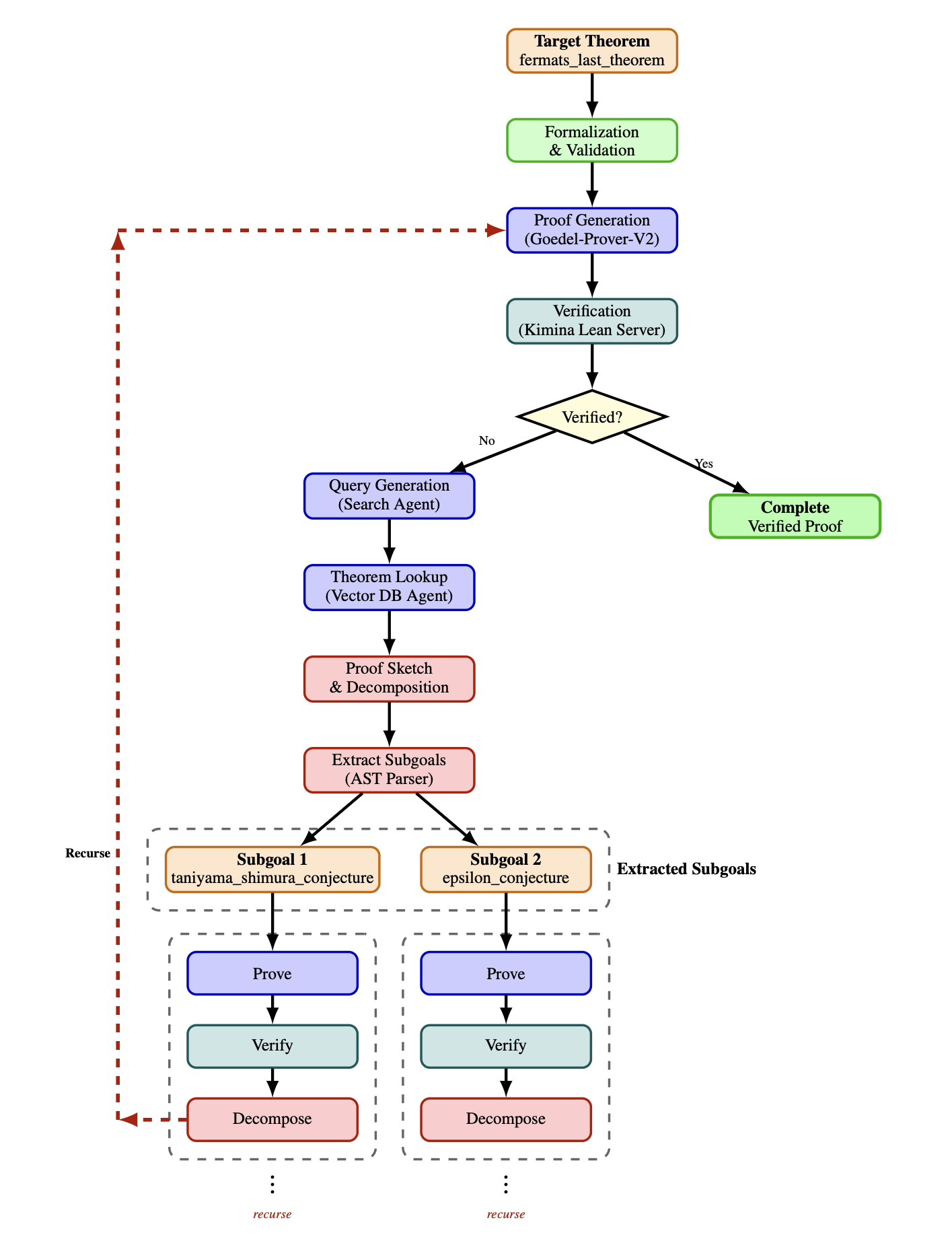
Illustrative subgoal names denote dependency shape only, not claims about those problems on miniF2F.
Evaluation and contribution
miniF2F is the formal olympiad-level benchmark cited throughout the paper. Pass rate means the fraction of items closed with a machine-checked proof under the pinned configuration (commit, endpoints, timeouts, harness flags—see the repository for the executable definition).
Under the manuscript’s configuration: 90.4% at pass@32 without recursive decomposition (i.e. direct Goedel-Prover-V2-style proving only); with decomposition and RAG, the paper reports a significant improvement—re-run the harness after any code change to obtain fresh numbers. The PDF tabulates one frozen run.
The technical contribution emphasized in the paper—and implemented in Kimina—is AST extraction from Lean 4 sketches so that decomposition stays programmatic: the proof sketcher can propose structure, but AST-based extraction and proof reconstruction tie that structure to obligations Lean actually accepts.
Reproducibility
Verification remains on Kimina; retrieval uses a local LeanExplore backend so indexed Mathlib matches the checker’s workspace. Agent backends are swappable via config.ini and SECTION__OPTION environment overrides; see README.md and CONFIGURATION.md.
References and citation
- arXiv abstract: https://arxiv.org/abs/2512.14252
- PDF: https://arxiv.org/pdf/2512.14252
- Source: https://github.com/KellyJDavis/goedels-poetry
- Documentation: https://KellyJDavis.github.io/goedels-poetry/
@misc{davis2025godelspoetry,
      title={G\"odel's Poetry},
      author={Kelly J. Davis},
      year={2025},
      eprint={2512.14252},
      archivePrefix={arXiv},
      primaryClass={cs.AI},
      url={https://arxiv.org/abs/2512.14252},
}
Limitations and threat models for autoformalization are discussed in the manuscript; routing, retries, env vars, and driver behavior should always be checked against the repository revision you execute.
— Kelly J. Davis